Fort Moultrie: Difference between revisions
No edit summary |
Bot: Automated import of articles *** existing text overwritten *** |
||
| (5 intermediate revisions by the same user not shown) | |||
| Line 1: | Line 1: | ||
{{PageHeader}} | {{PageHeader|Moultrie}} | ||
{{External|wikidata=Q1438645|wikipedia=Fort_Moultrie}} | {{External|wikidata=Q1438645|wikipedia=Fort_Moultrie}} | ||
'''Fort Moultrie''' (1776-1947) - Fort Moultrie is the name of a series of forts on Sullivan's Island, Charleston County, South Carolina, built to protect the city of Charleston, South Carolina. The first fort, built of palmetto logs, inspired the flag and motto (Palmetto State) of South Carolina. Named after [[William Moultrie]]. Closed 15 Aug 1947. | '''Fort Moultrie''' (1776-1947) - Fort Moultrie is the name of a series of forts on Sullivan's Island, Charleston County, South Carolina, built to protect the city of Charleston, South Carolina. The first fort, built of palmetto logs, inspired the flag and motto (Palmetto State) of South Carolina. Named after [[William Moultrie]]. Closed 15 Aug 1947. | ||
<gallery> | |||
File:FortMoultrie.jpg|Fort Moultrie | |||
File:Fort Moultrie HECP - 3M.jpeg|Fort Moultrie World War II Harbor Entrance Control Post (HECP) | |||
File:Fort Moultrie Panorama 1.jpeg|Fort Moultrie Panorama | |||
</gallery> | |||
== [[Revolutionary War]] (1775-1783) == | == [[Revolutionary War]] (1775-1783) == | ||
The fort was unfinished and unnamed when when Adm. Sir Peter Parker and nine British warships attacked it on 28 Jun 1776, near the beginning of the [[Revolutionary War|American Revolutionary War]]. Legend has it that the soft palmetto logs did not crack under bombardment but rather absorbed the shot; in any case, Charleston was saved from capture, and the fort was named for the commander in the battle, [[William Moultrie]]. | The fort was unfinished and unnamed when when Adm. Sir Peter Parker and nine British warships attacked it on 28 Jun 1776, near the beginning of the [[Revolutionary War|American Revolutionary War]]. Legend has it that the soft palmetto logs did not crack under bombardment but rather absorbed the shot; in any case, Charleston was saved from capture, and the fort was named for the commander in the battle, [[William Moultrie]]. | ||
| Line 23: | Line 22: | ||
{{Clr}} | {{Clr}} | ||
<Gallery> | <Gallery> | ||
File:Fort_Moultrie_1861-1865.jpg|Fort Moultrie with Fort Sumter In The Distance | |||
File:Fort_Moultrie_Interior_1865.jpg|Fort Moultrie 1865 | |||
File:Fort_Moultrie_after_1861_Bombardment.jpg|Fort Moultrie After The Bombardment of Fort Sumter, 1861 | |||
File:Fort_Moultrie_1861.jpg|Interior of Fort Moultrie, 1861 | |||
File:Fort_Moultrie_Shot_Furnace.jpg|Shot Furnace, 1861 | |||
File:Fort_Moultrie_Battery.jpg|Fort Moultrie Civil War Battery | |||
</Gallery> | </Gallery> | ||
| Line 61: | Line 60: | ||
==Current Status== | ==Current Status== | ||
Fort Moultrie is part of [[Fort Sumter]] National Monument. Many period guns and mounts are on display. Must see! | Fort Moultrie is part of [[Fort Sumter]] National Monument. Many period guns and mounts are on display. Must see! | ||
--- | |||
{{#display_map: | ==Context== | ||
{{Location|1214 Middle Street, Sullivan's Island, Charleston County, SC 29482|32.759382|-79.857666}} | |||
<!-- {{#display_map: | |||
32.759382,-79.857666~Fort Moultrie ; | 32.759382,-79.857666~Fort Moultrie ; | ||
32.75794,-79.85372~ Battery 230 ; | 32.75794,-79.85372~ Battery 230 ; | ||
| Line 76: | Line 78: | ||
32.75906,-79.8578~ Battery Lord ; | 32.75906,-79.8578~ Battery Lord ; | ||
32.76775,-79.81723~ Battery B - Fort Moultrie ; | 32.76775,-79.81723~ Battery B - Fort Moultrie ; | ||
32.759348,-79.857189~ HECP}} | 32.759348,-79.857189~ HECP}} --> | ||
<br> | <br> | ||
'''GPS Locations:''' | <!-- '''GPS Locations:''' | ||
{{GPSLocation|Fort Moultrie|32.759382|-79.857666}} | {{GPSLocation|Fort Moultrie|32.759382|-79.857666}} | ||
* {{GPSLinkLong|Lat=32.75794|Lon= -79.85372}} Battery 230 | * {{GPSLinkLong|Lat=32.75794|Lon= -79.85372}} Battery 230 | ||
| Line 93: | Line 94: | ||
{{GPSLocation|Battery Lord|32.75906|-79.8578}} | {{GPSLocation|Battery Lord|32.75906|-79.8578}} | ||
{{GPSLocation|Battery B|32.76775|-79.81723}} | {{GPSLocation|Battery B|32.76775|-79.81723}} | ||
* {{GPSLinkLong|Lat=32.759348|Lon= -79.857189}} HECP | * {{GPSLinkLong|Lat=32.759348|Lon= -79.857189}} HECP --> | ||
'''See Also:''' | '''See Also:''' | ||
| Line 108: | Line 108: | ||
* [http://www.civilwarhome.com/doubledaysumter.htm Abner Doubleday Account, Civil War] | * [http://www.civilwarhome.com/doubledaysumter.htm Abner Doubleday Account, Civil War] | ||
* [http://www.northamericanforts.com/East/sc2.html#harbor North American Forts - Fort Moultrie] | * [http://www.northamericanforts.com/East/sc2.html#harbor North American Forts - Fort Moultrie] | ||
[[Category:South Carolina Forts]] | [[Category:South Carolina Forts]] | ||
[[Category:Coastal Sites]] | |||
[[Category:Coastal | |||
[[Category:First System Forts]] | [[Category:First System Forts]] | ||
[[Category:Second System Forts]] | [[Category:Second System Forts]] | ||
[[Category:Endicott Period Forts]] | [[Category:Endicott Period Forts]] | ||
[[Category:Harbor Defense of Charleston]] | [[Category:Harbor Defense of Charleston]] | ||
[[Category:Restored]] | [[Category:Restored]] | ||
[[Category:Preserved]] | [[Category:Preserved]] | ||
[[Category:National Monument]] | [[Category:National Monument]] | ||
[[Category:Must See]] | [[Category:Must See]] | ||
[[Category:World War I]] | |||
[[Category:World War II]] | |||
{{PageFooter}} | |||
Latest revision as of 07:51, 21 August 2026
More information at Wikidata,Wikipedia
Fort Moultrie (1776-1947) - Fort Moultrie is the name of a series of forts on Sullivan's Island, Charleston County, South Carolina, built to protect the city of Charleston, South Carolina. The first fort, built of palmetto logs, inspired the flag and motto (Palmetto State) of South Carolina. Named after William Moultrie. Closed 15 Aug 1947.
-
 Fort Moultrie
 -
 Fort Moultrie World War II Harbor Entrance Control Post (HECP)
 -
 Fort Moultrie Panorama


Revolutionary War (1775-1783)
The fort was unfinished and unnamed when when Adm. Sir Peter Parker and nine British warships attacked it on 28 Jun 1776, near the beginning of the American Revolutionary War. Legend has it that the soft palmetto logs did not crack under bombardment but rather absorbed the shot; in any case, Charleston was saved from capture, and the fort was named for the commander in the battle, William Moultrie.
First System (1794-1808)

As tensions heightened after Great Britain and France declared war in 1793, the United States embarked on a systematic fortification of important harbors. A new Fort Moultrie, one of 20 new First System forts along the Atlantic coast, was completed over the decayed original fort in 1798. Destroyed by a hurricane in 1804, it was replaced by a Second System brick fort by 1809.
During the Second Seminole War, Osceola, a Seminole chief, and 200 Seminoles were imprisoned in the fort; Osceola's tomb is to the right of the sallyport entrance to Old Fort Moultrie.
U.S. Civil War (1861-1865)

Between 1809 and 1860 Fort Moultrie changed little; the parapet was altered and the armament modernized, but newly created Fort Sumter became the main component of Charleston's defense. Of the four forts around Charleston harbor, Fort Moultrie, Fort Sumter, Fort Johnson, and Castle Pinckney, it was Moultrie's defenders who chose to fight against the Confederacy; they retreated to the stronger Fort Sumter when in December 1860 South Carolina seceded from the Union. Three and a half months later, Confederate troops shelled Fort Sumter into submission and the U.S. Civil War began. In April 1863, Federal ironclads and shore batteries began a 20-month bombardment of Fort Sumter and Fort Moultrie; the Confederates held the forts and the harbor until February 1865, when the army evacuated the city. By then, Fort Sumter was a pile of rubble, and Fort Moultrie had been pounded below a sandhill, which subsequently protected it against Federal bombardment.
-
 Fort Moultrie with Fort Sumter In The Distance
 -
 Fort Moultrie 1865
 -
 Fort Moultrie After The Bombardment of Fort Sumter, 1861
 -
 Interior of Fort Moultrie, 1861
 -
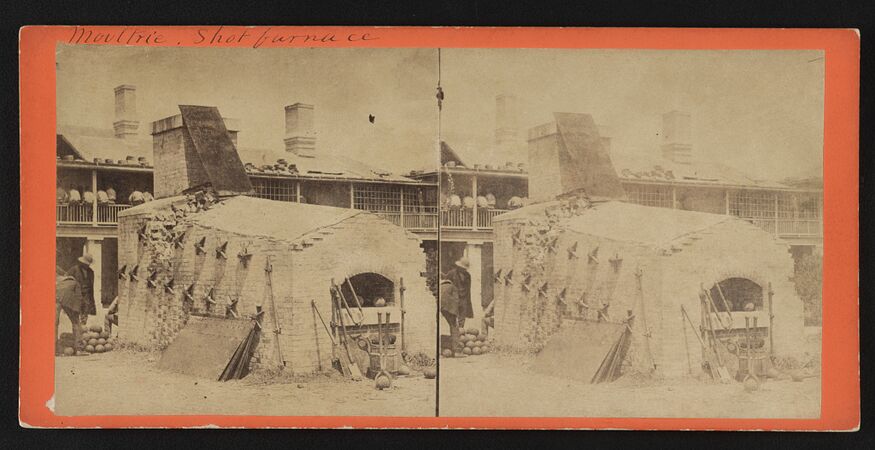 Shot Furnace, 1861
 -
 Fort Moultrie Civil War Battery


Post U.S. Civil War

Fort Moultrie was modernized in the 1870s, with huge rifled cannon and deep concrete bunkers; further modernization in the 1880s turned all of Sullivans Island into a military complex, of which the old fort was just a part. Fort Moultrie was upgraded during the Endicott Period and again during World War II.
Endicott Period (1890-1910)
Nine named concrete Endicott Period coastal gun batteries were built in and around the Fort Moultrie Reservation between 1897 and 1906. Only three of these were built into the structure of the old fort, Battery Bingham, Battery McCorkle and Battery Lord. Battery Jasper and Battery Logan were built on the main fort reservation facing south toward the harbor entrance. Battery Thompson and Battery Gadsden continued the line of batteries further east but off the main reservation, among the many vacation cottages on Sullivan Island. Also off the main reservation was the massive Battery Capron with sixteen 12" mortars covering the harbor and the entrance with all-around fire. This battery was later administratively split into two batteries and the second half was named Battery Butler. By the end of 1906, all of the Endicott Period batteries had been accepted for service and named.
Starting in 1902 a building program built out the post infrastructure to support the large numbers of officers and enlisted troops required to man the batteries. An impressive officer's row with eleven sets of quarters and an NCO row with 10 sets of quarters dominated the eastern end of the main reservation. In the central part of the post, a massive 289 man double barracks and two 161/121 man barracks provided housing for the single enlisted troops. On the north side of the western end of the reservation were another set of NCO quarters, a set of quarters for married enlisted troops, and a sixty-bed hospital.
| Battery | No. | Caliber | Type Mount | Service Years | Notes |
|---|---|---|---|---|---|
| Battery Capron | 8 | 12" | Mortar | 1897-1898-1898-1942 | All mortars scrapped & replaced in 1920 |
| Battery Butler | 8 | 12" | Mortar | 1897-1898-1898-1942 | All mortars scrapped & replaced in 1920 |
| Battery Jasper | 4 | 10" | Disappearing Carriage | 1897-1898-1898-1942 | 2 Guns removed in 1918 replaced in 1919 |
| Battery Thompson | 2 | 10" | Disappearing Carriage | 1903-1906-1906-1945 | |
| Battery Gadsden | 4 | 6" | Disappearing Carriage | 1904-1906-1906-1917 | |
| Battery Logan | 1 1 |
6" 6" |
Disappearing Carriage Armstrong Pedestal |
1898-1899-1899-1944 1898-1899-1899-1904 |
Gun removed 1904 |
| Battery Bingham | 2 | 4.7" | Armstrong Pedestal | 1898-1899-1899-1919 | 1 gun replaced 1980 |
| Battery McCorkle | 2 | 3" | Masking Pedestal Mount | 1900-1901-1901-1920 | 1 gun replaced 1980 |
| Battery Lord | 2 | 3" | Pedestal Mount | 1903-1903-1903-1946 | Destroyed |
| Source: CDSG
World War I (1917-1918)During World War I there was a large-scale program to dismount and ship large caliber gun tubes to the conflict in Europe on mobile mounts. After the war, some of the gun tubes were replaced but many were not. Following after the war, a great depression caused huge cuts in the military and many coastal gun batteries were abandoned because they could not be maintained. Battery Jasper had two of its guns removed and replaced. Battery Gadsden lost all of its guns and they were not replaced. Battery Butler and Battery Capron scrapped all sixteen of their 12" mortars but replaced them with eight newer models. Battery Bingham and Battery McCorkle lost all their guns in 1919-1920 and they were not replaced. By the end of 1920, only six of the nine Endicott Period batteries remained armed. The war also saw a large temporary building program to house not only the coastal artillery troops but troops being mobilized for the war. World War II (1941-1945)By the beginning of World War II, it was clear that many of the larger guns at Fort Moultrie were obsolete and they were quickly scrapped when the first large, quota-driven, scrap drive happened in late 1942. The eight 12" mortars of Battery Butler and Battery Capron and the four 10" guns of Battery Jasper were the first to go. Newer batteries were constructed that were a better match for modern ships, Battery 520 with two large casemated 16" guns and Battery 230 with two rapid-fire 6" guns. Both of these batteries were completed before the end of the war but Battery 230 was never armed. In 1944 a Harbor Entrance Control Post (HECP) was built into the left flank of the old fort and it remains there today, restored to its World War II look. The U.S. Army closed Fort Moultrie on 15 Aug 1947.
|
|||||

